
Upstate Tree Field Guide
The Trees That Fill Out Greenville's Canopy
By Jordan Hale
Greenville sits where the Piedmont rises into the Blue Ridge foothills, so the canopy mixes native hardwood forest with tree-lined streets, builder-planted ornamentals, and tall pines left standing after development.
Knowing the species explains what you're seeing. A willow oak's fine leaves, a sweetgum's surface roots, and a loblolly pine's storm behavior each lead to different pruning and care.
This is a homeowner field guide, not a botanical key. When health or structure is in doubt, pair identification with an arborist assessment.
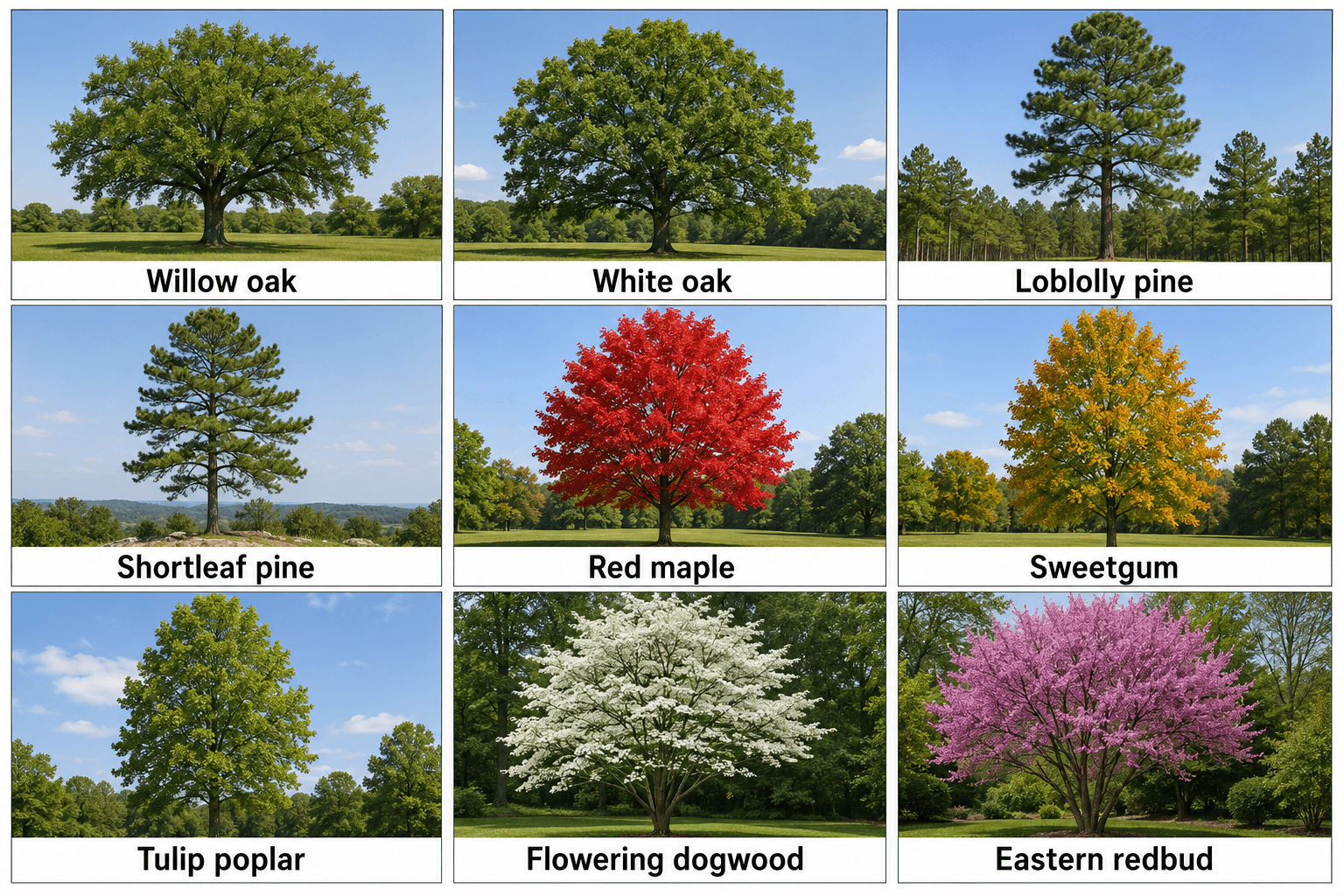
Trees That Shape the Upstate Canopy
These species show up again and again from downtown Greenville to the foothills and out across the Upstate.
Willow oak
A signature Upstate street tree with narrow, unlobed leaves and a broad mature crown. Older specimens need thoughtful end-weight reduction and roof clearance — not topping — as limbs stretch over homes and sidewalks.
White oak
Slow, long-lived, and great for wildlife, with rounded lobes and pale, plated bark. Protect roots during construction and prune structurally and sparingly.
Loblolly & shortleaf pine
Tall, fast pines common in subdivisions and larger lots. Watch for fresh lean, snapped tops, and root movement after long rain followed by wind — and heavy breakage under ice.
Red maple
A fast native found in yards and wetter spots. Opposite branching and red buds are the tells. Early pruning corrects crowded unions before they become competing stems.
Sweetgum
Star-shaped leaves and spiky seed balls give it away. Surface roots and large mature size cause conflicts on small lots, but well-placed trees deliver strong shade and fall color.
Tulip poplar
One of the tallest hardwoods in the foothills, with squared-off leaves and straight trunks. Fast height and brittle storm-damaged limbs make canopy checks worthwhile near structures.
Flowering dogwood & eastern redbud
Two beloved understory natives — dogwood's spring bracts and redbud's early purple blooms. Both prefer protected root zones and light, selective pruning over heavy shaping.
Identification Changes the Care Plan
Species drives mature size, decay patterns, drought response, pruning tolerance, and the season when work stresses the tree least.
It also sets what counts as normal. Peeling bark can be expected on one tree and a warning on another; surface roots can be a trait, not a failure.
Before heavy pruning, check the tree against our Greenville pruning calendar. If structure or health is uncertain, run through the hazard checklist.
Photograph the Clues That Matter
For ID, capture the whole tree, the branching pattern, bark, leaves or needles, any fruit or cones, and buds when you can.
Include the site. Soil moisture, root space, sun, and nearby construction often explain condition better than a single leaf close-up.
Send those with your project details and we can point you toward pruning, monitoring, or the right service.
Greenville Tree Identification Questions
What's the most common large street tree in Greenville?
Willow oaks are especially prominent in older Greenville neighborhoods and along many streets. White oaks, loblolly pines, red maples, sweetgums, and tulip poplars are also widespread across the Upstate.
Are Bradford pears native to South Carolina?
No. Bradford pear is a cultivar of invasive Callery pear — South Carolina has even run a bounty program to remove them. Their weak unions split easily, and replacing them with a native is usually the better call.
Can a tree be identified from a single leaf?
Sometimes, but bark, buds, branching, fruit, and overall form make it far more reliable. Hybrids and ornamental cultivars can be especially tricky.
Does species matter when deciding to remove a tree?
Yes, but never on its own. Expected lifespan, defect patterns, site fit, health, and the targets beneath the tree all weigh into the decision.
Keep reading
Related guides & services
Useful next steps from Greenville Arbor Co. across Greenville.
Need Help Reading Your Trees?
Send photos of the tree and whatever's got your attention.
We can help narrow the species and recommend tree trimming, an arborist assessment, or removal when it's warranted.